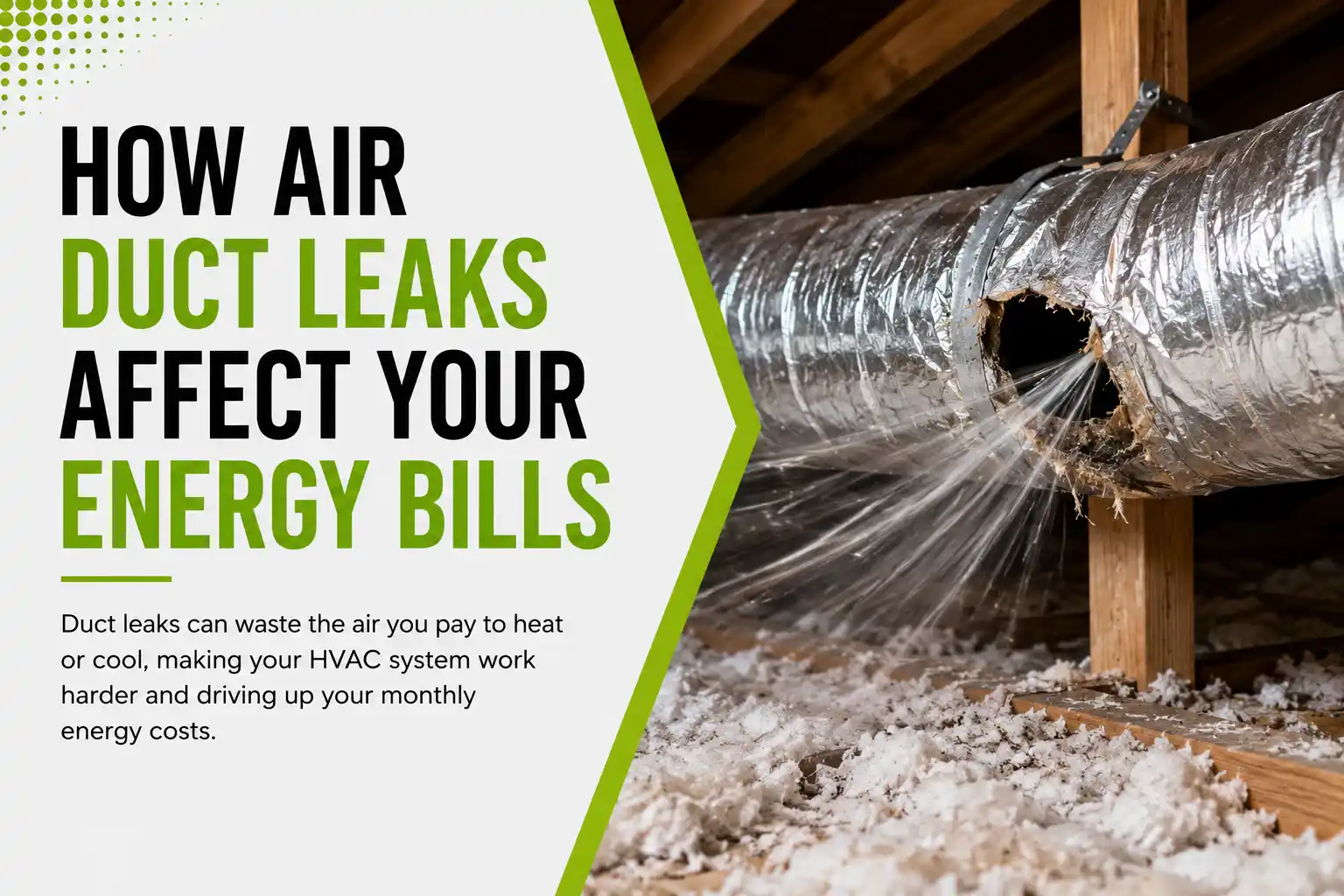

If your energy bills keep climbing and some rooms in your house never quite feel comfortable, leaky air ducts could be the reason. Air duct leaks happen when gaps or holes in your ductwork let cooled or heated air escape into the attic or crawl space before it ever reaches your rooms. In Plano, where summer cooling loads are high, this kind of waste can add hundreds of dollars to your yearly energy costs. Here’s what causes air duct leaks, how to spot them, and how Air N Fire finds and fixes them for homeowners across the area.
In this guide, you’ll learn what air duct leaks actually are, why they matter for your bills and your health, how technicians track them down and repair them, and what to look for when choosing a repair company in Plano.
What Are Air Duct Leaks?
Air duct leaks are gaps, holes, or loose connections in your ductwork that let conditioned air escape before it reaches your living space. They usually show up at joints, seams, or wherever two sections of duct connect.
Most homes run their ductwork through attics, crawl spaces, and other unconditioned areas. When a joint separates or a seam splits open, air pressure pushes that cooled or heated air straight out into those spaces instead of into your rooms. According to the U.S. Department of Energy, a typical home loses a significant portion of the air moving through its ducts to leaks and poor connections, especially where ductwork runs through attics or garages.
There are two basic types of duct leaks:
Supply duct leaks. Air escapes on its way from your HVAC unit to the vents in your rooms. You lose that conditioned air before it does you any good.
Return duct leaks. These pull unconditioned air, dust, and attic debris into the system, adding extra heat, humidity, or contaminants that your system then has to deal with.
Either way, your HVAC system ends up working harder than it should, which drives up your energy use and wears out equipment faster.
Why Do Air Duct Leaks Matter for Plano Homeowners?
Duct leaks matter because they raise your monthly energy bill and make certain rooms harder to keep comfortable. Plano’s climate makes this worse. Summer cooling loads are heavy, and a lot of local ductwork runs through hot attics, so any leak there gets amplified.
The Direct Cost of Leaky Ducts
When ducts leak, your HVAC system has to run longer to reach the temperature you set on the thermostat. That extra runtime shows up as:
Higher electricity or gas usage every month
Faster wear on the compressor, blower motor, and other parts
Uneven temperatures from room to room
Higher indoor humidity during the hotter months
Our breakdown on leaky ductwork and energy waste goes deeper into how even small gaps add up to real money lost over a cooling season.
Local Climate Makes Leaks Worse
Plano attics can regularly climb past 130°F in summer. If your supply ducts run through that heat and leak, hot attic air mixes with your cooled air, and your system has to work that much harder to compensate. Our guide on how weather affects Plano air ducts covers how local conditions speed up duct wear over time.
Air Quality Consequences
Leaky return ducts pull in attic dust, insulation particles, and sometimes pest debris, and all of that ends up circulating through your home. If you’ve noticed more dust than usual, allergy symptoms, or strange smells, it’s worth reading our piece on dirty air duct symptoms and health risks to see if a leak could be part of the problem.
How Does Air Duct Leak Detection and Repair Work?
Repairing duct leaks the right way follows a simple sequence: inspect, test, seal or replace, then verify. That’s the process Air N Fire uses on every residential duct repair job in Plano.
Step 1: Visual and Physical Inspection
A technician checks accessible ductwork in the attic, crawl space, or basement for visible gaps, disconnected sections, crushed runs, and damaged insulation. It’s the same starting point we use in our air duct inspection process for cleaning jobs, since inspection always comes first no matter what the end goal is.
Step 2: Pressure and Airflow Testing
Technicians use a duct blaster or similar pressure-testing tool to measure how much air the system is actually losing. This gives you a real number for leakage as a percentage of total airflow instead of a guess. Static pressure issues often point straight to leak locations too. Our guide on HVAC static pressure problems has more on how airflow problems get diagnosed.
Step 3: Locating Specific Leak Points
Using smoke pencils, thermal imaging, or manual tracing along the duct runs, technicians pinpoint exactly where the leaks are instead of sealing broad sections and hoping for the best.
Step 4: Sealing or Replacing Damaged Sections
Depending on how bad the damage is, technicians will:
- Seal small gaps and seams with mastic sealant or foil tape rated for HVAC use
- Reconnect and secure loose joints with mechanical fasteners
- Replace sections that are too damaged, crushed, or deteriorated to save
If the ductwork is old, corroded, or damaged past the point of a reasonable repair, full replacement is usually the smarter long-term move. Our page on when to replace your air ducts walks through how to think about that decision.
Step 5: Verification Testing
After the repair, technicians retest airflow and pressure to confirm the leak rate has actually dropped and airflow matches what the system is supposed to deliver.
Benefits of Fixing Air Duct Leaks
Sealing leaky ductwork pays off fast, often showing up on your very next energy bill.
Lower energy bills: Less conditioned air goes to waste, so your system doesn’t have to run as long to hit your set temperature.
More even room temperatures: Rooms farthest from the HVAC unit finally get the airflow they were supposed to have all along.
Less strain on your HVAC equipment: A system that isn’t fighting leaks lasts longer and needs fewer repairs down the road.
Better indoor air quality: Sealed return ducts stop pulling in attic dust and other contaminants. Our guide on improving indoor air quality covers this in more detail.
More consistent humidity control: Properly sealed ducts help your system keep up with Texas humidity instead of losing ground to outside air leaking in.
Better overall system efficiency: Sealed ductwork lets your system run closer to how it was actually designed to perform. See our page on HVAC system efficiency for more.
Common Problems and Mistakes with Duct Leaks
Most duct leaks come down to age, poor installation, or maintenance that got put off too long. There isn’t usually one single cause.
Common Causes of Air Duct Leaks
| Cause | How It Happens |
| Loose or disconnected joints | Duct sections separate over time from vibration or settling |
| Deteriorated tape or mastic | Old duct tape dries out and fails since it was never meant for long-term HVAC use |
| Pest damage | Rodents chew through flexible ductwork; see rodents in ductwork |
| Physical damage | Crushed or punctured ducts from attic storage or foot traffic |
| Poor original installation | Gaps left at connections during construction |
| Age-related wear | Ductwork over 15 to 20 years old is more prone to seam failure |
Mistakes Homeowners Make
Using regular duct tape instead of mastic or foil tape: Standard duct tape breaks down in attic heat within a few years, despite the name.
Ignoring uneven room temperatures: That’s often the first sign of a leak, not just a “vent problem” you can live with.
Skipping an inspection after a pest issue: Once you’ve found rodents, it’s worth checking the ducts for chew damage too. See signs of rodents in ductwork.
Assuming a higher bill is just normal for summer: A sudden jump in energy costs is worth looking into, not brushing off.
Sealing ducts yourself without testing first: If you seal the wrong spot, you’re wasting time and materials while the actual leak stays open.
Cost Factors for Air Duct Leak Repair
What you’ll pay for duct leak repair mostly comes down to how many leak points there are, how easy the ductwork is to access, and whether sections need sealing or full replacement.
A few things that affect the price:
How much leakage there is: A couple of small seam gaps cost a lot less to fix than several damaged sections.
How accessible the ductwork is: Ducts tucked into a tight crawl space cost more to reach than an open attic.
The condition of the material: Sealing is cheaper than replacing crushed or corroded sections.
Duct length and system size: Bigger homes with longer duct runs take more time and material to repair.
Residential versus commercial scope: Commercial ductwork often involves more extensive runs and access equipment.
For more general pricing context, take a look at our guides on air duct cleaning costs in Texas and hidden costs of air duct services, which cover related cost factors homeowners often don’t think about ahead of time.
Air N Fire gives you a clear, itemized estimate after the inspection, so you know exactly what you’re paying for before any work starts.
How to Choose the Right Duct Leak Repair Company in Plano
Look for a company that runs a pressure test before quoting you a price, not one that eyeballs the ductwork and guesses.
A few things worth checking for:
- Real diagnostic equipment. Duct blasters, thermal imaging, and smoke testing tools, not just a flashlight and an opinion.
- Clear, itemized pricing. A written estimate that spells out what’s being sealed or replaced and why.
- Local experience. A company that actually knows how Plano attics and regional ductwork behave.
- Licensed, trained technicians. Ask about credentials and experience with both residential and commercial duct repair.
- Before-and-after verification. They should retest airflow after the repair to confirm it actually worked.
- Honest recommendations. A company you can trust will tell you when sealing is enough and when replacement makes more sense, instead of pushing you toward the bigger job.
Air N Fire has worked on residential and commercial ductwork throughout Plano and the greater Dallas-Fort Worth area for years, and we lead with diagnostic testing and straightforward pricing so you get a repair that actually holds up. We also handle related services like air duct inspection and dryer vent cleaning in Plano, so your whole air system gets looked at, not just one piece of it.
Frequently Asked Questions
How do I know if my air ducts are leaking?
Watch for uneven room temperatures, energy bills that are higher than usual, weak airflow at the vents, dusty rooms, and visible gaps at duct joints in the attic. A professional pressure test will give you an exact leakage number, which is really the only reliable way to confirm a leak instead of guessing.
How much money can duct sealing save on energy bills?
It depends on the home, but the Department of Energy notes that sealing and insulating ducts in unconditioned spaces can meaningfully improve how efficiently your HVAC system runs. The exact savings depend on how bad your leaks are, how big your system is, and your local energy rates, which is why a pressure test matters before you commit to a repair.
Can I seal air duct leaks myself?
You can seal small, easy-to-reach gaps with mastic sealant or foil tape, but finding every leak in the system really requires pressure testing equipment most homeowners don’t have on hand. DIY sealing without testing tends to miss the bigger leaks hiding in hard-to-reach sections, so most of the energy loss sticks around.
How often should air ducts be inspected for leaks?
Most HVAC professionals suggest a full inspection every 2 to 3 years, or sooner if you notice climbing energy bills, pest activity, or uneven airflow. If your ductwork is older than 15 years, it’s worth checking more often since seams and connections weaken as they age.
Does duct sealing improve indoor air quality?
Yes. Sealing return duct leaks keeps your system from pulling in attic dust, insulation fibers, and outdoor contaminants. That means fewer particles circulating through your home’s air, which matters if you deal with allergies or notice dust building up around your vents.
What’s the difference between duct sealing and duct replacement?
Duct sealing fixes specific gaps, seams, and joints on ductwork that’s still in decent shape overall. Duct replacement comes into play when sections are crushed, corroded, chewed up by pests, or too worn out to hold a seal reliably. A technician can tell you which one your ducts actually need after taking a look.
Conclusion
Air duct leaks quietly push up your energy bills, wear down your HVAC system, and drag down your indoor air quality, and in a lot of Plano homes, that’s exactly what’s happening without anyone realizing it. The fix isn’t complicated. It starts with a proper diagnosis, pressure testing to find exactly where the leaks are, then sealing or replacing what needs it. Air N Fire’s inspection-first approach means you get an accurate read on your ductwork and a repair that actually holds up through a Texas summer.
If your energy bills have crept up or a few rooms never feel quite right, it might be time to have your ductwork checked. Reach out to Air N Fire and let’s find out what’s actually going on with your ducts.